
Adjusting notes within chords: suspensions and anticipations
Adjusting notes within chords: suspensions and anticipations
Harmony Signing’s principal purpose is to sign specific, stable chords in progressions. Nevertheless, participants are often attracted to the possibility of incorporating suspensions and other modifications of chordal harmony into progressions. There are ways of doing this, though they are dependent on careful signing so as to draw the attention of the appropriate performers to following the right hand rather than the left. A note given over to the right hand in this way is notated with a superscript R, as in 5R.
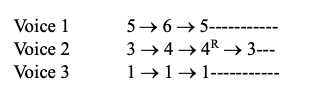
Take a progression such as our earliest experience of I→IV→I. Let’s consider the possibility of introducing a suspension to the final plagal cadence by signing the ‘liberation’ of note 4 to control by the right hand:
Voice 1 5→6→5———–
Voice 2 3→4→4R→3—
Voice 3 1→1→1———–
To achieve this successfully, attention needs to be clearly drawn to the note Fa being ‘liberated’ from its chordal function by signing the gesture for Fa with the right hand, and then holding it over (suspending it) while the left hand returns to the final chord I position. Once this suspension has been achieved, the right hand can resolve it by signing the descent back to note 3.
In rhythmic terms, the complement to suspension is anticipation, in which a harmony note is sounded prior to the chord change to which it belongs. In the following example of achieving this in a similar manner to a suspension, it is Voice 2 that is ‘liberated’ to respond to the right hand:
One further example of ‘liberating’ a voice from its position in a chord is to shift individual voices harmonically. Starting with chord I, we can consider moving each voice up or down a semitone. But some such moves have already been made possible through more robust procedures. For instance, moving note 1 of chord I down a semitone creates chord iii, for which we already have conventional sign (see [The secondary triads for Major and minor, and the full array of signs that vary the Primary Triad positions]). Similarly, sharpening note 1 creates a diminished 7th for which we have an existing procedure (see [The diminished triads and their role in modulation]). Flattening note 3 is better achieved through the gesture that turns chord I into i, its own minor (see [The minor mode]). Sharpening note 3 to note 4 adopts a similar procedure to the achievement of the suspension that we outlined above.
It is in varying note 5 that some exciting new possibilities emerge. ‘Liberating’ it from the chord with the right hand and flattening it by a semitone through the use of the fi hand-sign that we employ for both the flattened 5th and the sharpened 4th has the effect of accessing a harmonic aggregate associated with [The whole tone scale]:
Voice 1 5R→4# —
Voice 2 3 ————
Voice 3 1 ————
Moving note 5 up a semitone to si creates an augmented triad, a sonority often associated with magic that can also be derived from the whole tone scale. A chromatic move of this kind can also play a role in a longer passage:
Voice 1 5R→6♭→→5→→—-
Voice 2 3 ——— 2→→3—–
Voice 3 1 ——— 7→→1—–
Building on such an example, melodic ‘liberation’ of a voice against the sustained drone of the remaining two harmonies can provide a basis for more exploratory composition, such as in the following extended example (note that when a voice returns to left hand control, the superscript L is employed:
Voice 1 5R→6♭→→5→→4#→5L→→→→→→→→→→→→→→→→→→→
Voice 2 3→→→→→→→→→→→→→3R→2→→3→4→→3L→→→→→→→→
Voice 3 1→→→→→→→→→→→→→→→→→→→→→→→→1R→7→6→7→1