
Southern African Influences On Harmony Signing And Their Potential
While Harmony Signing is clearly derived in its methods and assumptions from the practices of European music since the Renaissance, and especially their codification in the Gradus ad Parnassum of Johannes Fux, as well as folk music, hymns and nursery rhymes, its original emergence owes a great deal also to a cappella vocal styles encountered over the same period from the Pacific Islands and Southern Africa. In particular, the research and performance of two residents of South Africa require acknowledgement: Dave Dargie and Pedro Espi-Sanchis. Both were courageously at the forefront of advocacy for native African music in education and the media prior to the ending of Apartheid in the 1990s. Both have stories to tell about police harassment in the course of their work – a clear threat, given that one of the instruments employed in both Xhosa and Zulu music, indeed throughout sub-Saharan Africa, is the hunting bow (see https://en.wikipedia.org/wiki/Musical_bow). As we shall see, the bow not only provides a key to the tuning systems of these musics, but also illustrates that their performers had their own, ancient theorisation of harmony well before European colonisation. Sadly, some musicologists remain convinced that harmony was unknown outside Europe, and was taken to places such as Africa, the Americas, New Zealand, Fiji and Tonga by Christian missionaries who employed it as a means of taming and converting the primitive peoples they encountered. It is high time that the truth be told, but we must leave this point for another occasion since it is beyond the scope of this contribution to the Harmony Signing website. However, in addition to Dave and Pedro, John Blacking should also be mentioned for his work on the transmission of musical repertoire and knowledge amongst the Venda people of South Africa and his subsequent book How Musical is Man?. In turn, Blacking’s own debt to the much earlier writings of Percy Grainger in A Commonsense View of All Music proved an inspiration to many of the ideas on which Harmony Signing depends.
Broadly, the features of African music-making that influenced the practice of Harmony Signing include:
- transmission of repertoire by imitation;
- performance by mixtures of child and adult performers;
- movement and gesture as inseparable elements of musical experience;
- often, self-sufficiently a cappella performance;
- harmony acquired through improvisation derived from widespread acceptance of the freedom to explore individual pathways that collectively result in heterophonic and polyphonic textures.
Both Dave Dargie and Pedro Espi-Sanchis worked with Southern African musicians who perform with musical bows or harmonic styles derived from their influence. Men’s bows are full-size, and sound at baritone range. Women’s bows are smaller, like children’s toys (which came first in human evolution, the child’s bow as a musical instrument, or the large man’s weapon on which his life might depend?). They sound at female range. But the critical point is that the bows, given limited sound-boxes, are virtually inaudible on their own. Their role is to provide a fundamental that resonates against the jaw-bone. And it is what happens next that reveals that Southern Africans have had a distinct understanding of harmony that goes back thousands of years. How do we know this? Because depictions of hunting bows have been found on the walls of ancient cave sites. (see Kumbani, J., & Vogels, O. 2022. Musical Bows in the Rock Art of Southern Africa. Oxford Research Encyclopedia of Anthropology. In fact, the earliest prehistoric depiction of a musical bow is on a cave wall in France. Music historian Curt Sachs proposed that many of the earliest bows found, some three meters in length, would have been too large for effective hunting). It would hardly be credible that people capable of making and employing bows would wait until modern Europeans arrived to show how to employ them as musical instrument! Besides, there is a further dimension to the practice of performing with the musical bow and its relation to harmony. Through employing the resonance of the oral cavity by placing the bow against the jaw-bone, the resulting harmonics can be varied. Yes, pre-colonised Africans employed the harmonic series. And their understanding of its properties has an additional outcome: they realised that by relaxing the muscles around the larynx, they could simultaneously vocalise the subharmonic an octave below the fundamental produced by striking or stroking the bow with a stick, giving rise to complex harmonies to which the voices of other performers could add their own doublings. This is what happens in the following video from Dave Dargie’s research in which a group of Xhosa women sing together in response to the leadership of the bow-player:
Xhosa bow-drone and female harmonic singing:
https://www.youtube.com/watch?v=H5ufUjLQBXk
In addition to his research into these traditional practices, Dargie was an ordained priest who encouraged the development of new, locally-derived liturgical repertoire through performance and ethnomusicological activities at the Catholic Lumko Pastoral Institute, near Lady Frere in the Eastern Cape. Published notations and recordings of the repertoire have spread around the world, and provide an insight into the potential of such fusion for preserving elements of traditional techniques in new contexts. One of the songs he has shared in workshops is an uplifting Halleluya in a swinging and energetic triple time. Having rehearsed this under Dargie’s direction and also heard the original Lumko recording, I felt that it lent itself to realisation through Harmony Signing, and this was one of the first songs to which we applied this technique with the Reading University Children’s Choir in the late 1990s.
Bass and harmony should be doubled and rhythmically decorated by as many tuned hand-drums as can be found, and the choral singing energetically and lustily projected. Similarly, the singing should contain gospel-style repetition of the word Halleluya in accompanying parts at the cadence such as bar 4.
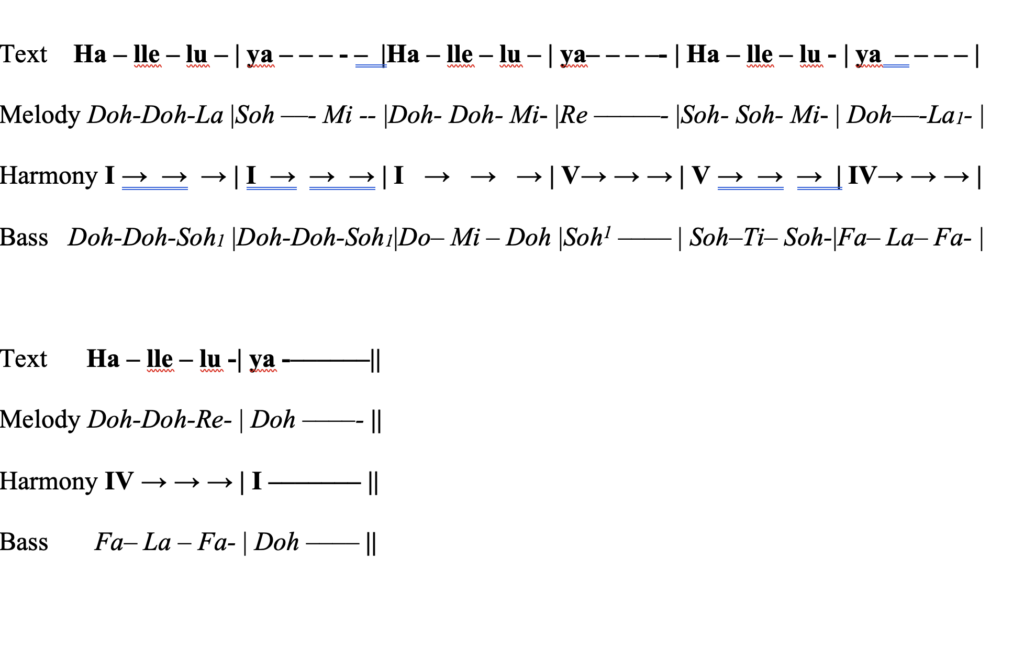
A further example of the kind of transcription Dargie made that retains clear African influences while being made available to choirs internationally can be heard in Ameni:
https://www.youtube.com/watch?v=onkynXPnimI.
Both Dargie and Espi-Sanchis performed alongside and studied the music of the singer known as Madosini. Now appearing under her full title Dr Latozi Madosini Mpahleni, she remains a remarkable exponent of the vocally-resonated bow harmony referred to above:
https://www.youtube.com/watch?v=3zaLhP0ceTM
Pedro Espi-Sanchis had his own TV show and regularly presented educational workshops around the world, not only on the music of South Africa but also on techniques employed in Namibia, Botswana, and Mozambique. Working with Madosini, he performed and taught the harmonic system of Xhosa music as well as the contrasting preferences of the Zulu style. The difference between fingering the string and its consequences for harmonic style in Xhosa and Zulu bow techniques is simply expressed: in Xhosa music, the ‘open’ and ‘stopped’ sounds are a whole tone apart, while in Zulu they are separated by the smaller interval of the semitone. Here is an example of this Zulu technique that can be compared with the recording of Madosini (above):
Zulu lullaby https://www.youtube.com/watch?v=e_4MTre-rUI
The most famous example of a Xhosa melody is probably the ‘click song’ Qongqothwane, referred to by the English designation because its text about the dung-beetle contains the distinctive and prominent consonants of the language that are produced through clicking the tongue in three different positions in the mouth. Melodically, the song employs the same two chords a whole tone apart as we have heard in the example sung by Madisini. Here it is performed in South African jazz style by Miriam Makeba:
https://www.youtube.com/watch?v=vhgb60Qsjrs
Students of the Ntonga Music School approach a more traditional, orally-transmitted style in the following recording of Qongqothwane:
https://playingforchange.org/click-song-guguethu/
The influence of these examples on Harmony Signing arose from the relationship of these two chords to the the harmonic language of Xhosa bow music. We first explored them in a version of the click song that we used to vocalise in the children’s choir. Given the Harmony Signing framework for the position and sound of the Primary Triads, we initially employed chords IV/V to capture the Xhosa progression. But it was always a concern that this led to the impression of a missing tonic. However, later, when the harmonic needs of sea shanties and songs such as Greensleeves were addressed (see [Mixed-mode challenges such as Greensleeves]), the development of chord 7♭ to the left of the body, employing the hand-shape for ta, presented a more authentic alternation required for Xhosa music that was better captured in the relationship between adjacent I and 7♭.
Zulu music, arising from their bowed style in which the fingering of the string gives rise to two pitches a semitone apart, is harder to represent in Harmony Signing, but a means of doing so is consistent with The gestures for moving up a tone or semitone without modulation. The signs for achieving this will be introduced there, together with their employment for the similar challenge of Flamenco.