The Full Chromatic Scale Employed In Harmony Signing
Quite early in the development of Harmony Signing with members of a children’s choir, it became apparent that limiting the numbers of signs for representing melodic pitch to the 12 visible on the piano keyboard proved preferable to employing the 21 signs required to reflect the theoretical location of pitches within the extended tonal system. As a consequence, enharmonic equivalences are embraced:
C#=D♭; D#=E♭; F#=G♭; G#=A♭; and A#=B♭.
Recall that the majority of performative responses to Harmony Signing are in the form of wordless singing (or, eventually, instrumental playing). From that perspective, it is the sounds of pitches that counts, not the notational conventions required to represent them, nor their relationship to practising scales.
As a consequence, Harmony Signing employs in the gestures presented by the right hand a 12-note chromatic scale that can be conceived in Sol-Fa terms as:
Doh-Di-Re-Ma-Mi-Fa-Fi-Soh-Si-La-Ta-Ti-Doh1
An effective means of learning the relative intervallic tunings of this array is to divide a group into two, one of which sustains the drone while the other is led through the intervallic potential of the chromatic scale. On completion of this, the groups can swap, so that everyone experiences the intervallic consequences from both perspectives. Even more formative of Harmony Signing confidence is to have everyone sign what is happening while they sing, experiencing aurally the consequences of the gestures while enacting them. (Note that the two Voices swap roles half way thriough, though Voice 1 performs the drone at the upper octave, permitting everyone participating to build their aural discrimination of intertvals in both inversions)
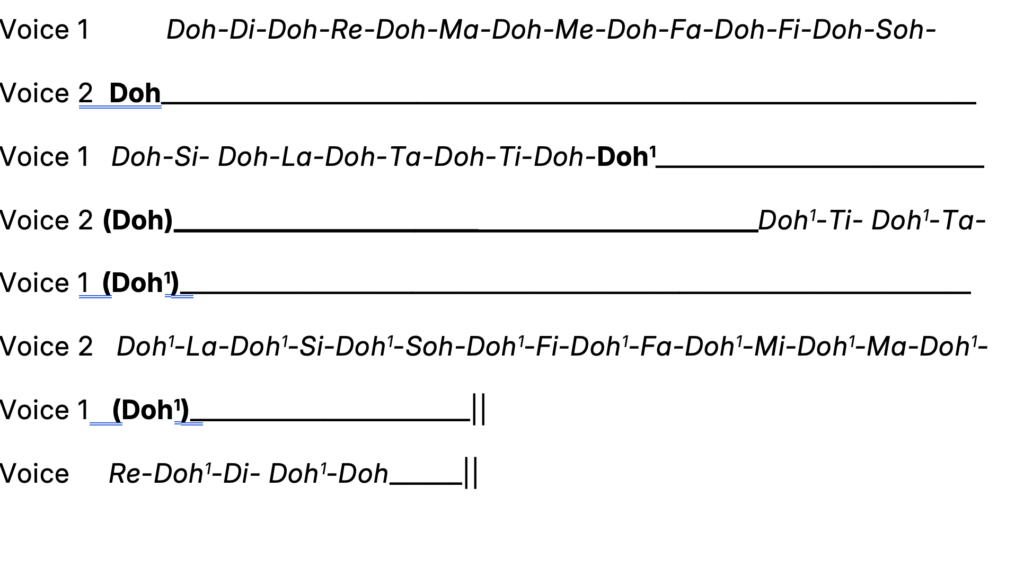
Here is a more advanced, integrated version of this, which should be performed slowly so that the sound of each interval can be experienced clearly in its unique sonority:
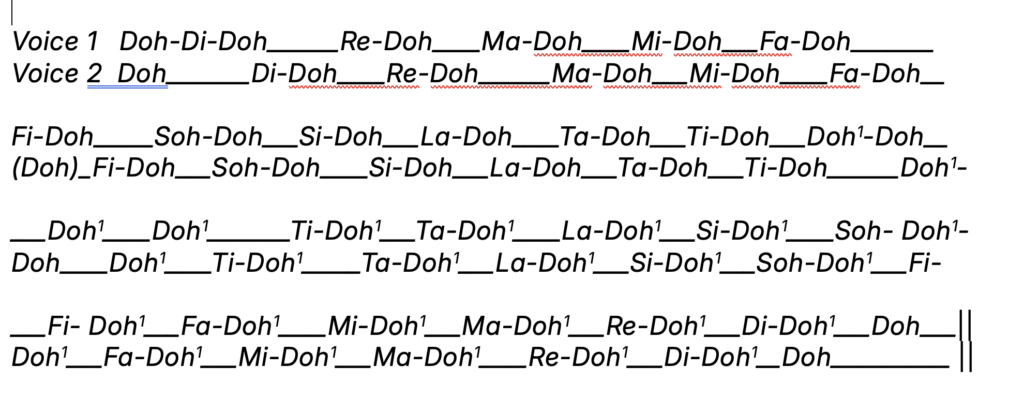
While, in teaching these, it may be useful initially to sing the Sol-Fa names, the true aim should be to perform them wordlessly to a vowel such as AH or OO. Examples of these are available in Videos 13-14. Where appropriate, these exercises can also be attempted with participants playing a variety of instruments.
Such exercises can also be rendered as an even more colourful and harmonically instructive challenge by dividing into three voices, leaving the drone unsigned, and leading the two moving parts with both hands on the following lines :
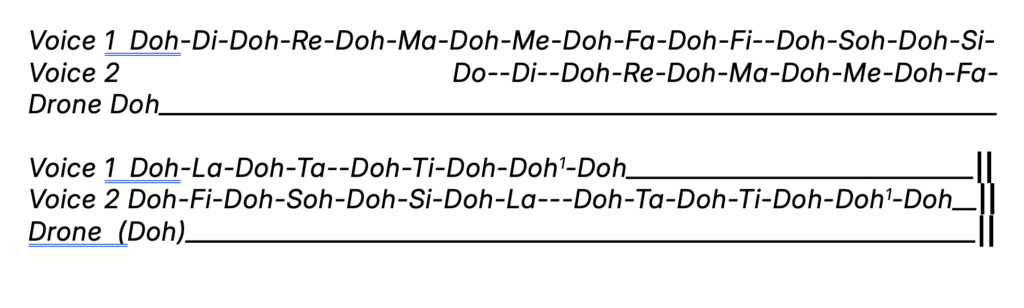
A variety of further exercises could be devised that vary aspects of this approach, such as changing the rhythmic relationship of the entry points. Advanced students can devise 12-note rows and lead their performance in this same manner.
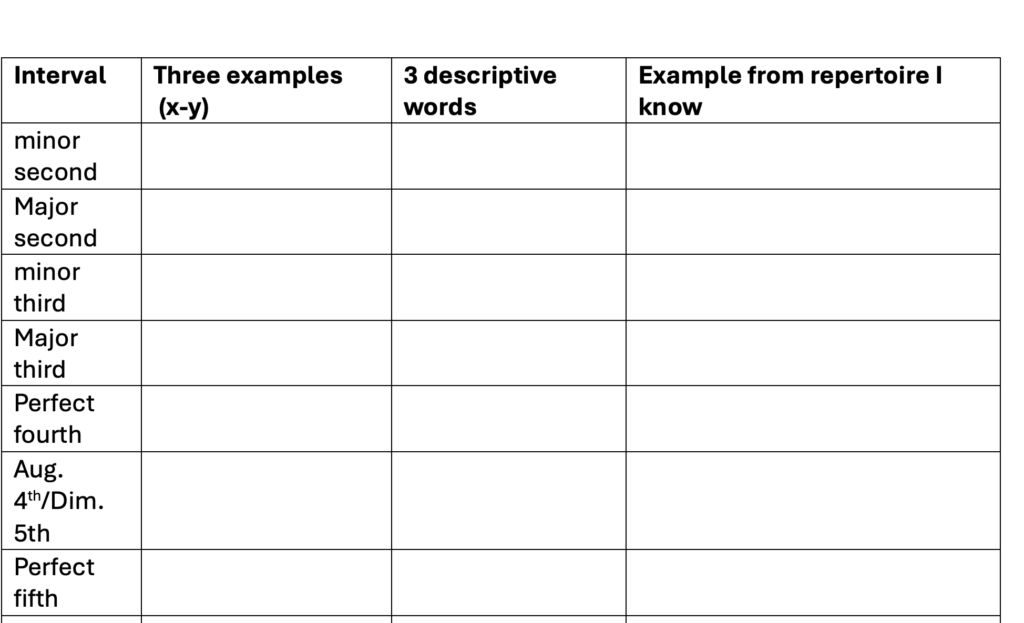
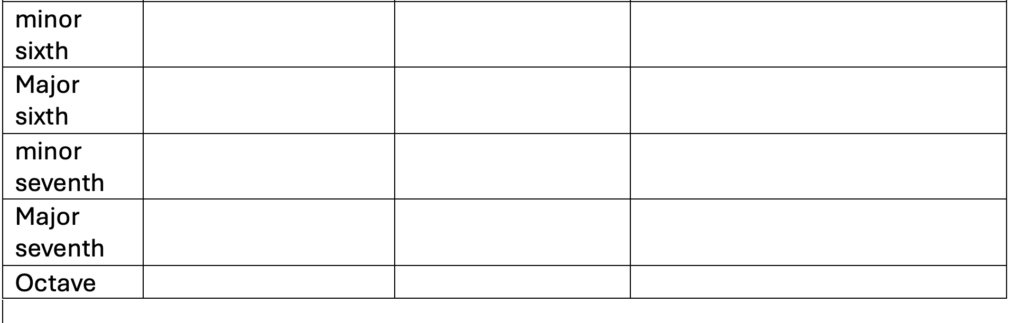
A useful support to the intention of these chromatic exercises in learning to discriminate all the intervals within the octave, is to suggest that every student create their own personal Interval Chart, drawing exclusively on their unique experience, discrimination and preferences. Charts on these lines are often provided to classes with all of the links to repertoire and experience defined in advance to be learned as gospel. It is far more effective if, over a period of weeks, individuals devise their own responses and selections, since these will make memorable links to the practical experience in class led through the Harmony Signing exercises. A chart could be devised on the following lines, assigning information to four columns:
(i) Interval (name)
(ii) Three examples (x-y)
(iii) 3 descriptive words for each that helps build assoications of interval quality rather than quantity
(iv) Example from repertoire I know
These should be set out in order for all of the following:
1 minor second
2 Major second
3 minor third
4 Major third
5 Perfect fourth
6 Aug. 4th/Dim. 5th
7 Perfect fifth
8 minor sixth
9 Major sixth
10 minor seventh
11 Major seventh
12 Octave
The descriptive words of the third column may include a music-theory term (e.g. ‘consonant’, dissonant’, etc.) but more usefully represent associations of the interval that are uniquely capable of capturing the personal experience of each student so that only that interval provides the experience noted. This is ‘homework’, and it is the responsibility of each student to take this chart away and think for themselves about what makes each interval distinctive to them, playing them on a keyboard, or in collaboration with a friend, until the specific character of each interval is revealed. Similarly, in the final column, it proves far more memorable if students select for themselves the occurrence of each interval in repertoire with which they are themselves personally familiar than providing lists of songs that it is assumed they know, but which may provide little enlightenment if they do not.
Given the range of pitches now available, it is possible to explore the harmonic and melodic properties of The whole tone scale and The octotonic scale/second mode of limited transposition.
A sample Chart that can be copied is given here: