The Octatonic Scale
The octatonic scale began to appear in music from Russia and Eastern Europe as folk-inspired chromatic exploration defined stylistic innovations. Traceable in the music of Mussorgsky and Rimsky-Korsakov, it makes a significant contribution to the sound-world of Stravinsky’s 1913 masterpiece The Rite of Spring. Olivier Messiaen codified the scale as ‘The Second Mode of Limited Transposition’, and its harmonic potential colours many of his works.
The scale can be represented in melodic signing as follows:
Doh – Re – Ma – Fa – Fi – Si – La – Ti – Doh1
Its distinctive sound derives from its proceeding through alternating steps of tones and semitones. This provides uncertain but colourful harmonic possibilities. The scale contains no Perfect 5th above its tonic, but is otherwise rich in possible aggregates. Here is an initial selection of the colourful 4-note harmonies available, read from left to right:
Doh – Ma – Fi – La
Doh – Re – Fi – La
Doh – Ma – Fi – Si
Doh – Ma – Fa – La
Ti – Re – Fa – Si
Ti – Ma – Fi – La
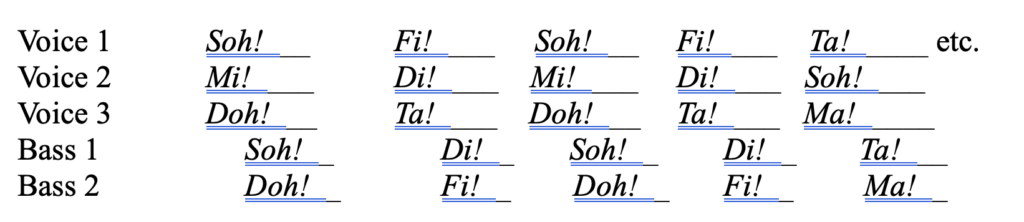
One could derive these chords in four parts through starting on Ti or Doh and proceeding up the scale until each of the 4 voices arrives at a specified pitch. A brief snippet with octatonic characteristics arranged from The Great Gate of Kiev, the final movement of Mussorgsky’s Pictures at an Exhibition, could be signed in four parts as follows:
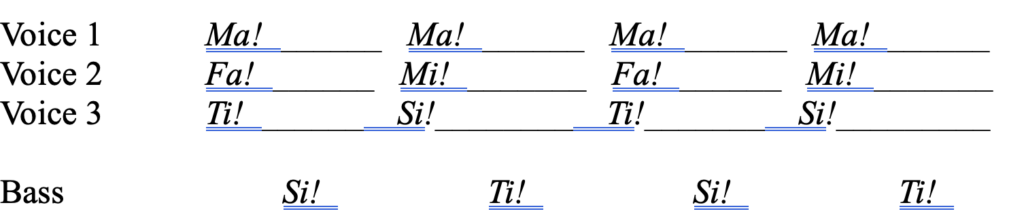
The bell-like tolling of these chromatic chords gives rise to a pianistically virtuosic representation of them that is visual in its effect.
Chromatic departures of this kind need not be fully octatonic to introduce novel harmonic progressions. A similar texture to the Mussorgsky provides the mystical character to this passage from Saturn in Holst’s The Planets: