
Adding Bass Lines And Getting Into Four Harmonic Parts
Participants in and observers of Harmony Signing have sometimes remarked that, to their ears, the method lacks clarity in not being founded on bass lines. Student of Bach chorale harmonisation and the role of the continuo in Baroque and early Classical music, will share this concern. However, one needs to remind oneself of the manner in which the foundational practices of Harmony Signing first emerged: in the voices and creative experimentation of primary age children. The clef in use in any notation they employed was the treble. Their voices easily adapted to sharing the close distribution of triads in root position, first and second inversion. But bass lines played no part in their experience unless supplied by the voice of an adult, or performed on the piano.
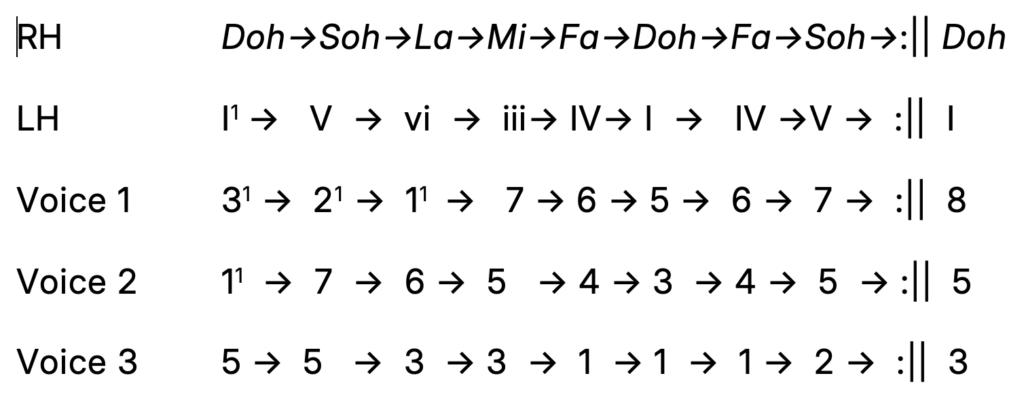
When working with older students and, eventually, with instruments, an entirely valid and productive variant of Harmony Signing is to add a bass line that is signed by the right hand employing Kodály hand gestures. In The secondary triads for Major and minor, the mixing of Primary and secondary triads and the gestures for them permitted the direction of the chords of Pachelbel’s Canon. We can now illustrate the addition of the bass line which gives this progression its harmonic strength (a version close to the original voice leading of the chords is also provided that participants should be capable of reproducing from the signs provided by the leader):
The potential for rhythmic independence of bass line and harmonic progression can be illustrated by this ground bass from Purcell’s Evening Hymn:

Rock music is frequently underpinned by powerful bass riffs, such as this one from the Rolling Stones’ song Satisfaction:

Participants should be encouraged to seek out other bass riffs or ground bass patterns and prepare to sign them with their group. The potential of working in four parts provides a powerful new opportunity within Harmony Signing.