The Secondary Triads For Major And Minor
If you have already read and understood Getting started with Harmony Signing, and, even better, you have built up practical experience of performing and signing the initial preliminary material covered there, you will already be aware that the vital starting-point of the method is the set of three gestural positions for the Primary Triads: chord I with the left hand held horizontally in front of the chest with the edge pointing towards the participants; chord IV with the hand similarly edge-on but pointing vertically upwards; and chord V with the fingers pointing vertically downwards. These three positions and the harmonic relationships they represent are the foundation for everything that has been built on them, from Modulation, Tonicising, Access to the circle of fifths and the use of The diminished triads to advanced chromatic variants of these initial techniques.
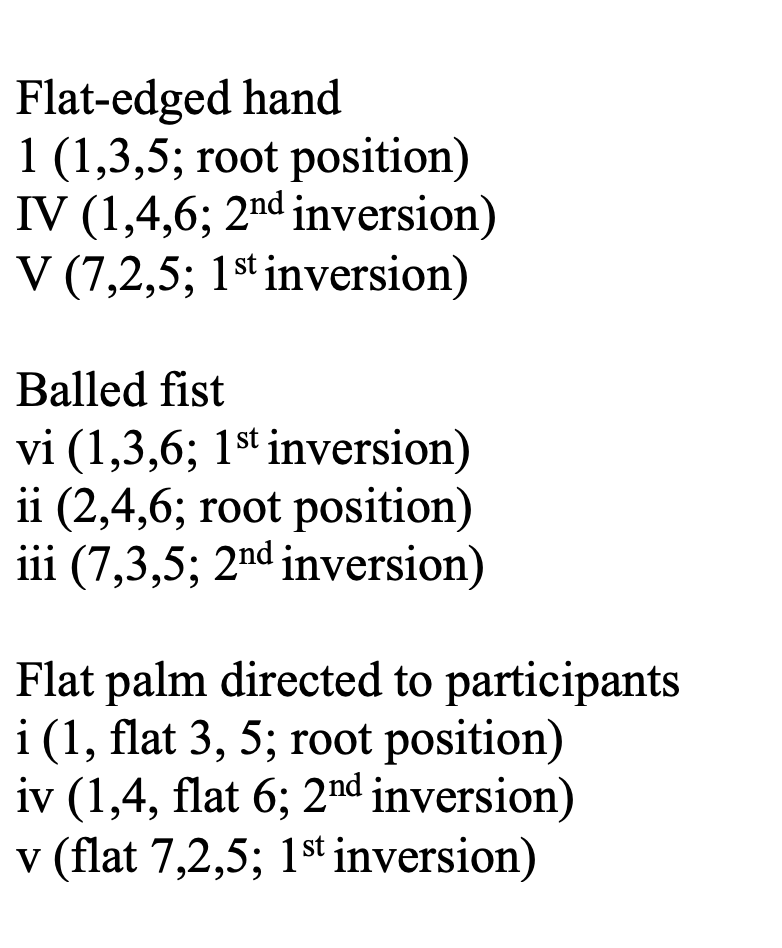
The secondary triads present first significant additional to the harmonic vocabulary that has been established so far. For each Primary triad, there is a secondary triad associated with the equivalent arm position. The use of <P> for Primary and <s> for secondary will already have provided the hint that, where the Primary Triads are all Major, the secondary triads are all minor. The relationships are even more elegant: each Primary Triad gives rise to a secondary triad whose root is a minor third below it – a relative. As a means of aurally discriminating these harmonic relationships, it is useful to build both the gestural representation and the aural contribution we make while contributing as performers to the chord on such easily remembered symmetries. For each of these moves (I→vi; IV→ii; V→iii), the hand moves from having the palm open, with the edge facing the participants, towards a balled fist.
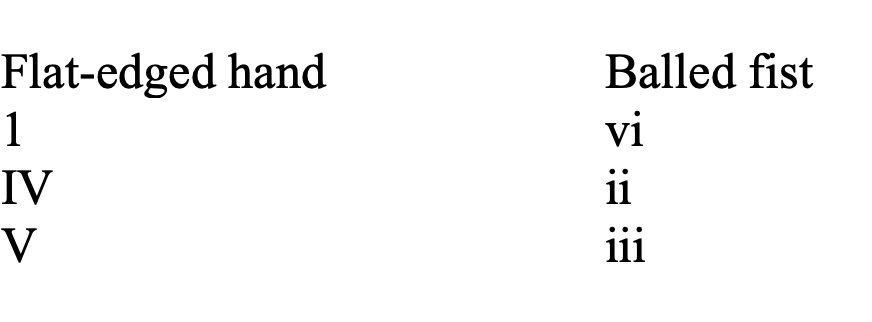
It helps elicit the correct interpretation in the voice-part responsible for rising the whole tone which turns the Major chord into its minor relative if a small additional movement is made to suggest this: note 5 to note 6 for I→vi (a slight shift to the right); note I to note 2 for IV→ii (a slight extension upwards); and note 2 to note 3 for V→iii (a slight shift downwards). Meanwhile, everyone else sustains the pitch they started on, which is shared across both chords.
This now permits six notes of the scale to provide a triad of which each is the root: three Major and three minor. Currently missing is a chord on note 7, though we can access that when we explore The minor mode and when we introduce The diminished triads. We can now sign progressions such as that on which Pachelbel built his famous Canon:
I1→V→vi→iii→IV→I→IV→V
A challenge that will prove valuable at this point is to seek out and perform melodies that use as many of these chords as possible (the Pachelbel omits chord ii: what songs employ it?), and assign each to a member to prepare lead it in your group.
Accessing all of chords I, ii, iii, IV, V and vi is a huge and useful step. Remember that these all relate to the pitches of the Major, the Ionian mode. What happens when we begin instead in the minor?
Harmony Signing employs doh minor as its means of representing the minor mode, and does so precisely to reflect the alternative symmetry whereby chords I, IV and V can all be turned in similar fashion into chords i, iv and v. The gesture required for this depends on turning the palm of the hand, fully, to face the participants, a little like a warning sign. The voice-leading required only affects those performing the third of each of the Primary Triads:

Notice in examining this chart that there are, again, symmetrical and complementary features to these relationships that may contribute to their memorisation, and to discriminating them in later performance and aural work. This question of ‘who moves?’, as well as ‘how far?’, underpins the teamwork through which the interactive, shared responsibility for mutual musical exchange and cooperation provides the experience on which the development of these musicianship skills depends. For instance, the moving voice in turning a Primary Triad into a secondary triad rises a whole tone, while the only voice to move in turning a Primary triad into its minor version falls a semitone. If students can all hear these features for themselves, as well as controlling them in taking turns to lead exercises and progressions that they have individually devised, they will have acquired robust and expressive musical understanding that can be transferred to engagement with notation, analysis and instrumental improvisation.
In summary, the two kinds of hand-gesture variant of the initial Primary Triad position, through either turning the palm forward or balling the fist, now give rise to a ninefold array of distinct yet integrated harmonic standpoints: