
Tonicising
The ‘tonicising’ sign plays an essential role in defining what chord should sound in participants’ subsequent response to the signing of the Chord I horizontal position within the framework of the Primary Triads. Modulation can only occur where one key usurps another: often through procedures defined by stepwise replacement around the circle of fifths, but also through more distant chords being brought into this central position and legitimised as the new working tonic by use of the tonicizing sign. The sign operates as confirmation of an anticipated completion of the process set in motion earlier in a progression, and it is vital that it is clearly employed in advance of the left hand reaching the central position so that participants can discern without doubt that a modulation is intended.
The tonicising sign is a right-handed gesture in which the index finger points beckoningly towards the position in which the left hand will subsequently adopt the chord I tonic signification. It is important that the hands are coordinated in achieving this relationship so that confusion of purpose is avoided.
Examples of the tonicizing sign being employed to confirm modulation in this way are presented in Videos 20 and 21, and are further evident in Videos 73 and 74.
The circle of fifths is often presented in a diagrammatic form through which the 12 pitches of equally tempered music are set out in a pattern resembling a clock face. Movement ‘clockwise’ illustrates modulation in a ‘sharpwards’ direction through ascending fifths, the ‘old’ dominant becoming the new tonic. Anticlockwise movement illustrates ‘flatwards’ movement, through descending fifths.
Harmony Signing views modulation to the subdominant as the most natural process, and the first to be introduced (see Video 55). This assumption takes its cue from the way in which the harmonic series contains the seeds of its own harmonic instability through the audible presence of a flattened 7th that occurs as the seventh harmonic over the fundamental (singing the vowel sounds described in the opening notation of this in What happens at a workshop – usually at the vowel Ah – and you can experience this for yourself). Acoustically, it goes with the grain of how we hear sound: one just legitimises the undermining of chord I by adding its 7th, and the use of the tonicizing sign to show that a new tonic has taken the central position confirms the inevitable. By comparison, modulation to the dominant requires a more complex process of replacement that requires an additional step: first, the sharpened 4th needs to be introduced, which is signed by a left-hand gesture based on that for the note fi, moved horizontally to the left of the body outside the normal positions of the Primary Triads (see Video 19). This results in the major version of chord II. Following this, the tonicizing sign will confirm that ‘old’ chord V is anticipated to move to the chord I position, signalling that a modulation will be completed.
While the tonic can be undermined simply by adding a dominant 7th to it, a fuller understanding of the opposed and complementary nature of movement around the circle of fifths follows from the explanation of modulation to the dominant just given. This required movement of the left hand ‘outside the body’, in that case through a hand shape associated with the sharp form of the 4th degree of the scale, fi, a variant, through the thumb pointing upwards, of the Kodály sign for fa. The complement to this is to move the left hand outside the body but complete the movement with the hand-sign that involves the index finger pointing downwards. This is the sign for ta, the flattened variant of ti. We have achieved the introduction of (see Video 55) the flattened 7th previously by employing the circular finger-to thumb shape that indicates that the chord has become a dominant 7th. The significant difference in moving the left hand fully to the left for the ta shape is that it designates the entire chord of the flattened 7th: notes 2, 4 and the flattened 7th of the previously prevailing scale. There are melodies that require this chord, common in sea shanties and certain rock and world music styles. Whether or not its introduction leads to modulation depends on the use of the tonicising sign. The moment that this is provided through pointing to the central position with the right hand, participants will anticipate that the old tonic has been usurped.
Flatwards and sharpwards modulation permits access to keys outside the stable and foundational positions defined by the visible, kinaesthetic and audible associations of the Primary Triads, which is why it is so important that participants experience these deeply and expressively both as performers and leaders prior to taking these new steps outside their initial position. The introduction of fi and ta is a game changer that opens up the understanding of compositional processes which underpin the styles of widespread composers, but that tend conventionally to be explained diagrammatically, in music notation, or through the use of Roman numerals. Experience in working with these modulations will help to embed them in the aural imagination so that they become familiar in both purpose and effect.
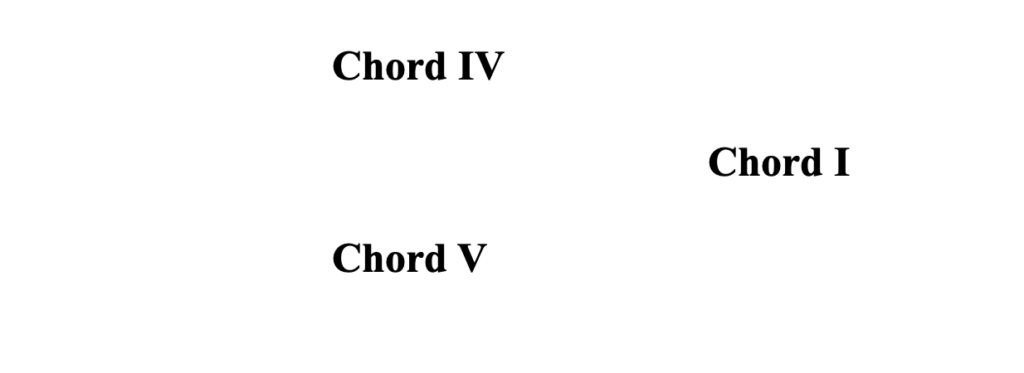
A visual representation of what has been described may clarify its significance. The Primary Triads are signed in three positions in front of the body that can be represented as follows:
Were one to attempt to map this onto the entire clockface of the usual diagrammatic representation of the circle of fifths, it would appear something like this:
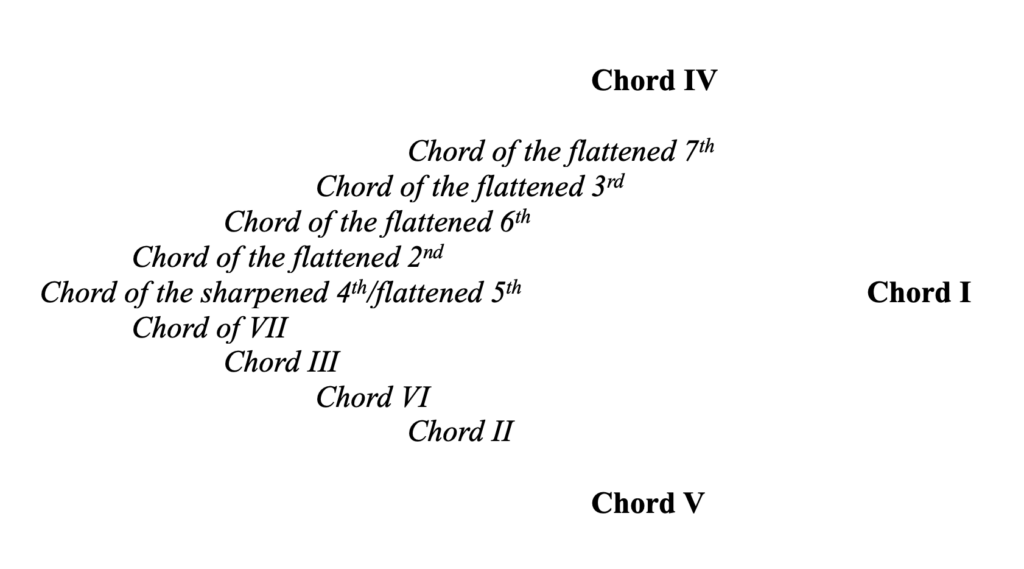
In a manner that owes more than a little to the theoretical model of the musicologist Heinrich Schenker, Harmony Signing preserves the precedence for tonal music of the Primary Triads as defining the sense of key through which we discern the narrative processes of music: the feeling of home. The other chords are not buried or dismissed: they are there, awaiting the transformational or modulatory processes that may call them into use. Meanwhile, the positions associated with the Primary Triads are themselves capable of modification – see also:
The chord of the flattened 7th and its potential
Access to the circle of fifths