The Minor Mode
The initial experience of Harmony Signing, both in its melodic employment of Kodaly hand-signs and in its foundational positions for the Primary Triads I, I and V, has been in the Major mode. Harmony Signing embraces the minor mode as a variant of these procedures, unlike the Kodály principle of locating it as based on the Aeolian relative mode based on La. The reasons for this are bound up in the semiotic efficiency of relating Major to minor (note the employment as a convention of capital M for Major and lower case m for minor). The use of Harmony Signing with the young, taken together with the emphasis on sung responses that employ wordless singing rather than note-names, determined that the relationship between sound and symbol needed to be as memorable and straightforward as possible. In addition, the interchangeability of major and minor encountered in Western music from the 19th Century onwards, especially in works by composers such as Schubert, Brahms and Richard Strauss, as well as in folk music and sea shanties, illustrated the appropriateness of moving from Major versions of chords to their minor through the most simple and conventionalised gestural modification. Decorative or passing chord-replacement can thus be signalled without implying a change of mode. But by employing the [tonicizing sign], the direction can clearly be expressed ‘the music is now in the minor’ through pointing with the index finger of the right hand directly at the sign for the tonic minor, the horizontal arm with the palm of the hand facing towards the participants.
So, each of the Primary Triads can in this manner be turned into its minor version through turning the palm outwards, as if in a warning sign. Initial practice in achieving this in a well-tuned manner, the Perfect intervals of each chord (1 and 5 in I; 1 and 4 in IV; 2 and 5 in V) sustained without change while each third (3 to flat 3 in I→i; 6 to flat 6 in IV→iv; 7 to flat 7 in V→v) falls the required semitone. Practising these moves while all participants listen closely plays a vital part in developing a secure understanding of the interaction of voices which allows Harmony Signing to take effect as a framework for musicianship and aural discrimination. Through such procedures, participants acquire reliable associations of the essential responses required of them: ‘who moves/who stays?’; and ‘a tone or a semitone?’ (in this case the moving parts are limited to semitones, but this forms the basis of comparison with other procedures in which parts may need to move or whole tone or even a minor 3rd (see Dominant sevenths). They also develop a deepened experience and understanding through devising progressions that signal progressions which employ these relationships. As ever, taking on the signing role provides a complementary perspective on the sound that it is important everybody experiences.
Equally important for both signers and singers is to acquire complete familiarity with the melodic signs for the minor mode. The melodic minor is set out as follows:
Doh- Re-Ma-Fa-Soh-La-Si-Doh1 – Ta-Si-Soh-Fa-Ma-Re-Doh
Purists may object to the employment of the sharpened 5th sign, Si, to represent the flattened 6th. The purpose of this accords to the following justifications: (1) that Harmony Signing is essentially a gestural system, and learning to respond to the gestures is made more efficient through limiting their number (see The full chromatic scale employed in Harmony Signing) rather than requiring the learning of a full array of some 21 signs by young participants, and the potential for confusion and hesitation this would lead to; the Kodály note-names are only really used to designate such pitches as a means of establishing the gestures for them. Once melodic responses to pitched signs has been acquired, they can largely be dispensed with, and participants vocalise to an AH sound. This prepares much better for the transfer of melodic response to instruments once participants are ready to attempt this.
Vital to the process of building from response to the Primary Triads in a manner that securely establishes well-tuned responses shared by all participants to the questions ‘who moves/who stays?’ and ‘when moving, is it a tone or a semitone?’ is the practice of exchanging starting-notes so that everyone fully understands the array of voice-leading responsibilities they are called on to perform. A useful test for this is to observe the extent to which participants discern the difference between moves from the Primary Triads to their respective minor versions, and moves from the Primary Triads to the secondary triads (see The secondary triads for major and minor, and the full array of signs that vary the Primary Triad positions). Mistakes need only be made by one or two participants, and these can be rendered unclear. Further practice needs both to remind everyone of the correct moves, and provide all participants with the opportunity to sign this wider selection of chords so as to extend the development of acoustic anticipation and inner hearing.
Once this set of moves attains fluency, participants will possess a robust sense of the nine-fold harmonic array that can be built from the original Primary Triad positions. This can be summarised thus:
Starting again with the conventional positions of the Primary Triads, we can transform all three of them into minors by turning the palm of the hand to face participants as if presenting a warning sign. Thus I→i, IV→iv and V→v. Significantly, in such transformations, two notes (1 and 5) remain consistent and only the third (mediant) of each chord (3) moves down a semitone to define the change from major to minor.
This leads to a controlled proliferation of chord types whereby the original three provide access to nine distinct triads (3 x 3):

A vital outcome of this arrangement is that participants can acquire a sense of the inversion in which each triad is presented that they can learn to categorize in terms of both the voice-leading connections and the intrinsic complementarity of intervallic distribution.

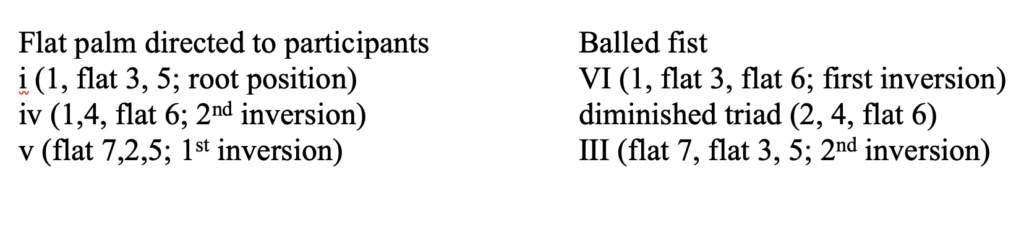
To complement these moves that commence in the Major mode of the Primary Triads, one should also practise the consequences of commencing in the minor mode, signed by confirming this with the tonicising sign pointing towards the position of the left arm and hand for chord i. This leads to the following relationships, whereby the consequent variant effects on chords in the three secondary triad positions respond to the minor tonality: