
Dominant Sevenths
Dominant seventh chords exist in nature, since the seventh partial of the harmonic series clearly sounds out the pitch that derives from a 7:1 frequency ratio with the fundamental (see Getting started with Harmony Signing, Exercise 1). In constructing instruments such as the piano, craftsmen had to take special care to suppress this harmonic response in order to retain a clear sonority, for instance in the placement of dampers. One often hears church bells that possess a strong 7th harmonic, and exploration of the harmonics available on stringed, wind and brass instruments will illustrate how easily it can be produced deliberately. Indeed, it featured in the music written for brass instruments in the Baroque and Classical eras prior to their being fitted with valves, and the slight variation in tuning can be heard to convincing effect in period practice performances of music by composers such as Bach, Mozart and Beethoven.
In Harmony Signing, the principal purpose of introducing dominant 7ths is to access modulations to related keys (see Tonicising and Access to the circle of fifths). Of course, signers are welcome to employ them for other purposes: for instance, to provide an authentic harmonic colour to Blues progressions, or to capture the impressionist shading associated with the music of Debussy and Ravel.
The sign for adding a dominant 7th to an existing Major triad is produced by moving the hand into a position in which the index finger forms a ring with the thumb. It helps performers to see this occur if a small movement of the arm is made in achieving this. So, moving in this way from chord I to chord I7 has audible consequences: it conventionally anticipates the undermining of the tonic in preparation for modulation. If this is the intention, then the tonicizing sign (right hand index finger pointing to the left-hand central position) confirms it to be, and, through slightly withdrawing the left arm and then re-presenting it in the chord I position, the tonic will be assumed to be replaced by ‘old’ chord IV – a modulation to the subdominant.
Clearly, adding a note to a chord means either quitting one of its existing pitches, or dividing (if only momentarily) into four parts. When composing notated music, as in a trio for three instruments, one would adopt the former solution. But Harmony Signing is an improvised group activity, and performing chords in their fullest voicing provides the greatest level of fluency that has outcomes in discrimination and practical music theory application. The voice-leading for this is as follows:
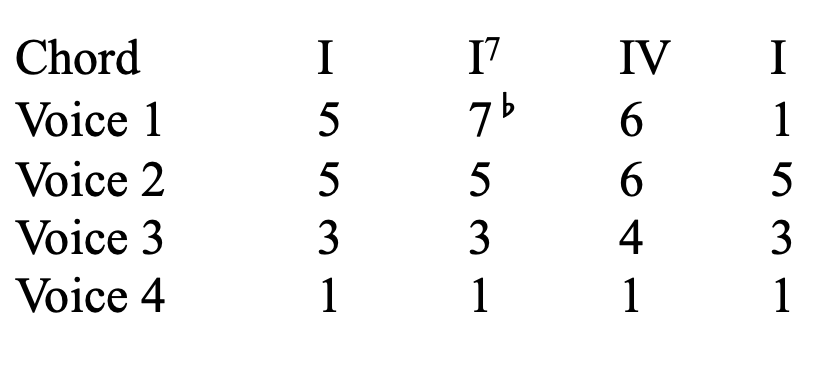
See Adding bass lines and getting into four harmonic parts for further examples of this and four-voice music in general.
The seventh sign can, once this initial treatment if familiar, be added to any Major chord. Working with the remaining positions of the Primary Triads, it can give rise to the following modulation:
IV→IV7→’old’ chord flat VII enters the tonic position, I.
By comparison, adding the 7th to chord V has the consequence of strengthening anticipation of return to the tonic:
V→V7→I
For this reason, composers sometimes exploit this conventional role by delaying the anticipated tonic return and moving elsewhere – usually to chord vi:
V→V7→vi
This relationship is known in the British music theory community as an ‘interrupted’ cadence, and in American as ‘deceptive’.
Adding a seventh to a minor triad, while it is achieved by employing the same thumb-to-forefinger ring symbol, has different implication to those dealt with above for Major triads, and will be addressed in Short cuts to alternative modulatory pathways.