
Short Cuts To Alternative Modulatory Pathways
The potential for changing key as a procedure available within Harmony Signing has been introduced in considering Modulation and the signing of Dominant sevenths. These processes have also arisen as supportive of Access to the circle of fifths. However, the procedures already presented allow Harmony Signing to embrace the potential for modulations of the kind that emerged with the increased chromaticism introduced in the works of 19th Century composers which permitted changes of tonal centre to be more dramatic, abrupt and structurally expressive.
We should first review the various means by which modulation can be accomplished. One is the formation of a dominant 7th from a major chord using the sign in which the index finger of the left hand forms a ring with the thumb. Followed by the tonicising sign in the right hand, the index finger pointing to the left-hand tonic position, participants anticipate that the next chord will resolve this tension by completing a perfect cadence in which the new chord I takes its rightful place. Another example is through the use of chord II, signalled by the left arm moving outside the body to a horizontal position in which the hand adopts the sign for the sharpened 4th, fi. Again, through displaying the tonicising sign, this permits a modulation to be completed. These two processes yield modulations to the subdominant and dominant respectively.
The following examples illustrate the potential of combining the implications of introducing non-scale tones that indicate possible modulation through use of the tonicising sign to confirm the intention to access more distant tonal destinations. The examples begin with those that commence in the tonic major, before then considering the quite different potential of the minor mode. It is worth stressing that for these operations to work, all participants need to be both confident and fluent with the tonal and intervallic consequences of what is signed, and be able to anticipate the musical relationships involved.
Amongst the ways in which new modulations can be accessed from the tonic major are the following:
1 Use of The diminished triads.
These symmetrical chords made up of adjacent minor thirds represent a significant arrangement of harmonic potential that derives from an intervallic layout with the most distant relationship to those of the harmonic series. Little wonder that Romantic composers treated them as polar opposites to the Primary Triads, and relished both employing them cadentially and exploiting their capacity for abrupt key-change.
The diminished triad we will initially introduce is that which acts as a variant of the dominant seventh of our key chord. It is signalled through crossing the index fingers of both hands centrally at waist height, clearly below the position for chord I. The response should be as follows:
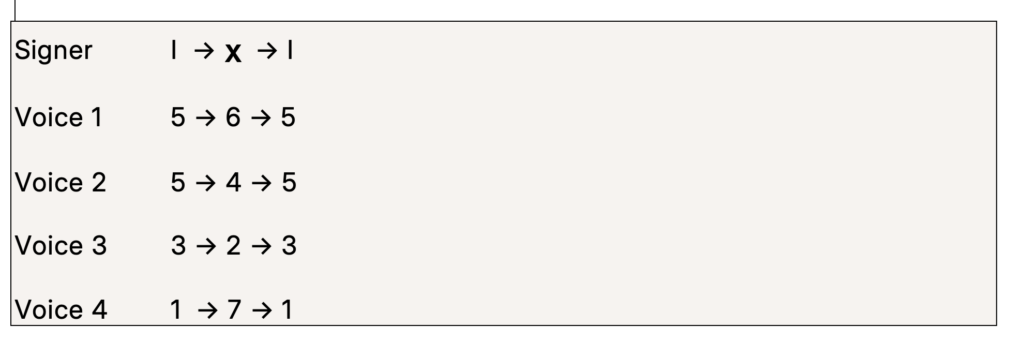
By ‘liberating’ a voice within the diminished triad sonority, we can incline the tonal implication towards a different destination, presenting a dominant 7th that suggests entry to a new key. Then, employing the tonicising sign to confirm that a modulation has occurred, we can complete the cadence in the tonality anticipated. There are therefore three new destinations to which this process can take us:
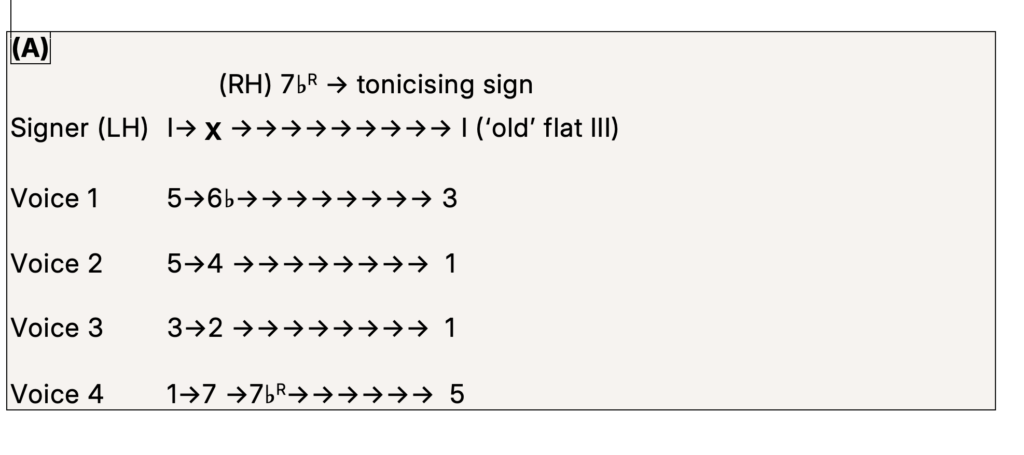
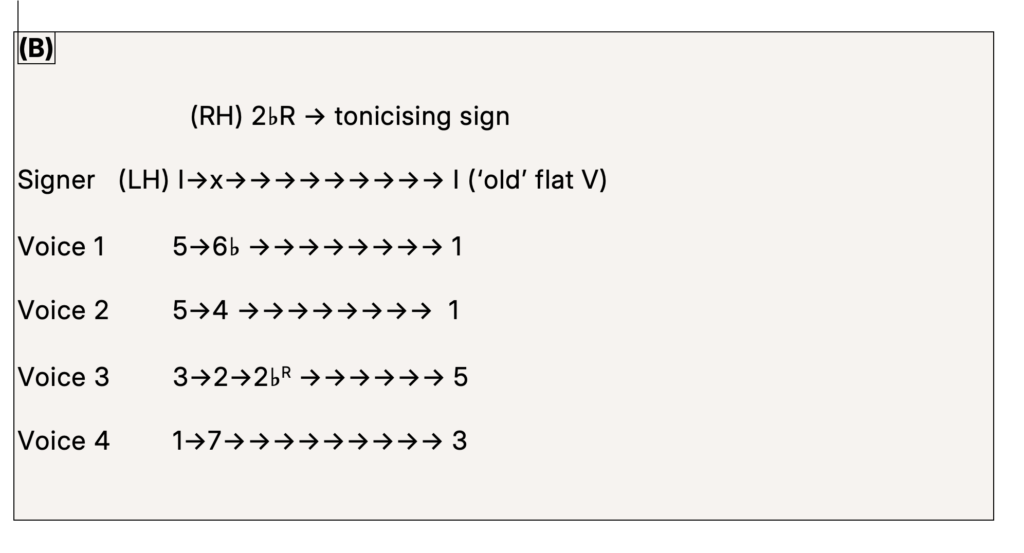
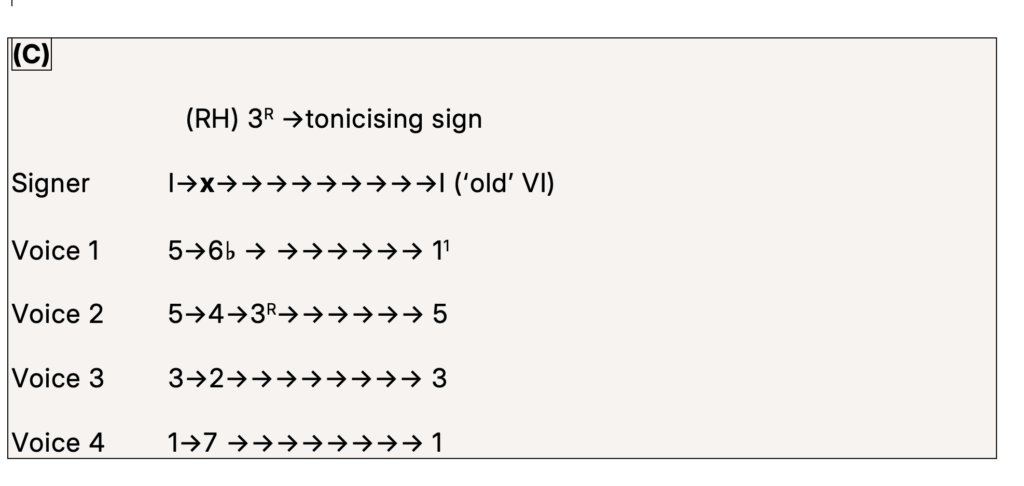
These modulations – to the flat mediant, the very distant chord on the diminished 5th, and the major submediant – are all enabled via the diminished triad on note 7. A further set of different tonal destinations, eight in all, are available through applying similar processes to the diminished triads on note 1 and on note 1#. Indeed, passing through the diminished triads in this manner illustrates their capability, like musical wormholes, to link to any key of the circle of fifths.
2 Some further modulatory ‘side-slips’
Once participants are fully fluent with the kinds of operation described above, they may be ready to attempt some even more subtle modulatory procedures that depend on confident listening and a cooperative group capacity to infer tonal direction. For instance, the tonicising sign can be used twice in succession, first to signal that the anticipated minor triad is to be heard as the new tonic, and secondly to turn it into its own major. Once can first attempt this through a clear set of separate steps – only once these prove successful might one attempt to streamline the signing.
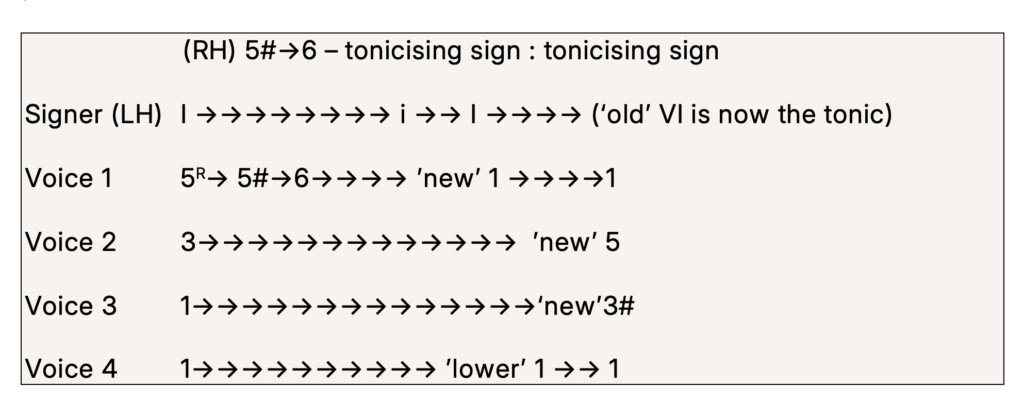
Signers and participants who can cope with this level of harmonic alteration will be ready to experiment with devising further pathways of this kind that link to keys initially remote from the tonic major.
3 Modulations away from the tonic minor
For these examples, each progression begin on the tonicised minor, chord i. The first exploits the Major identity of chord VI in the major:
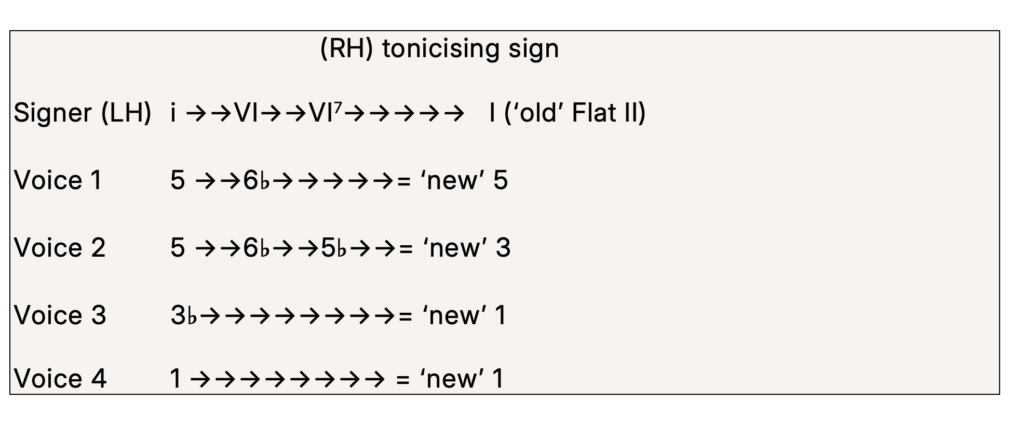
This is a useful preparation for the key-change ‘up a semitone’ that figured prominently in 50s and 60s pop music as well as popular hymns such as Thank you for giving me the morning.
A different pathway is opened up by moving via chord III:
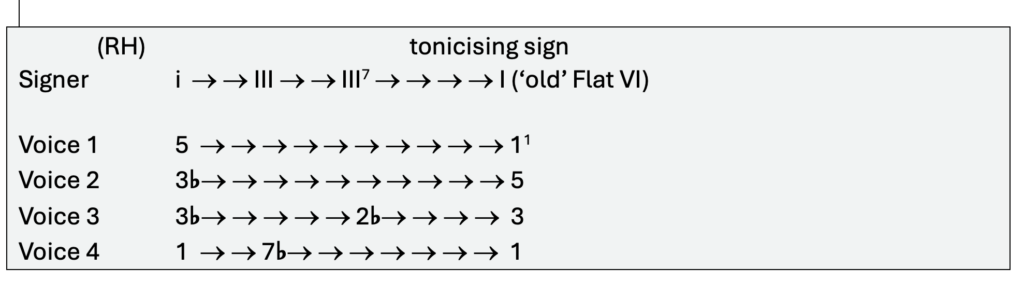
Again, confident signers working with experienced performers will be able to employ innovative combinations of the signs and procedures introduced so far to attempt a wide range of chromatic modulations that preserve the integrity of the method while discovering new pathways between tonal areas. The more varied the experience thus gained, the more that all members of the group will develop creative insights into the possibilities of organised acoustic phenomena.