
Leading Two Part Music With KodáLy Signs
In addition to signing chord progressions founded on the three positions for the Primary Triads, and to employing the right hand to combine melody with the left-hand accompaniment, a valuable contribution to Harmony Signing pedagogy involves the use of Kodály hand-signs in both hands to direct two-part polyphony, both composed and improvised. The purpose of this is to provide a complementary technique to the primarily heterophonic progressions of Harmony Signing through exploring the time-honoured potential of polyphony based on two independent voices.
The significance of this is partly functional and partly pedagogical. Many of the principles of Harmony Signing recognise the influence of Johannes Fux and the education of composers that he set out in his Gradus ad Parnassum (1725). Fux’s preliminary exercises present the processes of voice-leading that define the pathways performers take through chord change, establishing the aural connections that avoid parallel fifths and awkward leaps. Experience of these compositional values can be sharpened and expressively extended by applying to two-handed melodic signing a programme of exercises derived from the ‘species’ of Fux’s method. In turn, the techniques acquired can be applied in standard Harmony Signing where left-hand gestures accompany right-hand melody: the implied voice-leading of the harmony will respond better to its relationship with the shape of melodies devised. But two-handed melodic signing also permits exploration of imitative counterpoint: the melodic phrases supporting one another through one being delayed to independently accompany the other. An advanced version of this can divide a group between two leaders, the second following the first while both employing one hand each; or even getting into 3 or 4 parts where signers and participants have sufficient experience to manage this. While this may seem complex, it could be built towards through signing familiar rounds such as London’s Burning or Frère Jacques.
Exercises derived from Fux’s species can contribute to learning these kinds of skill through the following steps. All of these should be carried out vocally, though experienced participants can later transfer them to the use of instruments (see Working with instruments):
A leader signs a unison melody that proceeds only by step. There should be sufficient alternation of upwards and downwards motion to prevent giving the impression of a scale on the one hand, or of a repetitive alternation of the same two notes on the other (a ‘trill’).
Here is an example:
Doh – Re – Mi – Re – Mi – Fa – Soh – Fa – Mi – Fa – Mi – Re – Doh
Everyone in the class should have the chance to lead in this manner (see also the ‘alap’ examples in Videos 3 and 4);
A signer leads the singing of the scale up and down in canon:

This could be initiated using note-names and then be performed to a legato AH sound. It can prove a particularly useful exercise in commencing signing with instrumentalists;
A leader signs a similar melody as above, starting with one hand and, after two beats, commences a second voice with the other hand. Only parallel motion and contrary motion should be employed, and attention paid to sustaining independence of contour as much as possible so that the second part is not the mere slave of the first. Crossing parts is entirely legitimate. Here is an example:

These exercises have so far moved from unison to polyphonic interaction based on notes of the same duration, with voices always moving by step in a consonant relationship. The next level, which leads to the employment of intervals between voices other than the unison and third, introduces variant durations, commencing with some notes being twice the length of others. Here are two examples:
(A)

(B)

The time has come to introduce melodic intervals larger than a step – leaps. Initially, these will be of a third, and follow two stipulations: (1) following a leap, the next pitch ‘comes inside’, moving back to the note leapt over; (2) leaps should not at this stage take place in both voices at once.
In order to exercise these conventions before attempting them in two parts, leaders should sign melodies along the following lines over a sustained drone in the second part. (This will inevitably give rise to passing notes – see below – and other intervals dissonant with the drone, which should otherwise be avoided at this stage when these conventions are applied to working in two parts):

Building on this level of experience, we can explore the initial introduction of more elaborate two-part polyphony through accompanying a similar kind of melody with ‘moveable drones’ signed in the left hand (see Video 35 for a similar example):

If we reverse the roles of the voices, the ‘moveable drone’ can also be in the upper part:

Intervallic spaces can then expand further, though always ‘coming inside’ afterwards to a pitch ‘within’ the leap, whether up or down.
Here is an example with some wider leaps. It is important that as many leaders as possible gain the opportunity to direct the group with these most recent procedures:

2-part melodic polyphony represents an ideal medium for exploring the phenomenon of dissonance in a manner that reflects its treatment in Fux’s account. A number of other Harmony Signing techniques have introduced dissonance, including Dominant sevenths and Adjusting notes within chords: suspensions and anticipations. The following exercises are best studied in relation to their coverage in these other pages. The principle polyphonic dissonances we will deal with are: passing notes; suspensions; and anticipations;
Passing notes embrace momentary dissonances between a melody and a drone or a voice and a sustained pitch in another voice. They take two forms, unaccented and accented. Unaccented, as the term suggests, take place between consonances, as in this example:
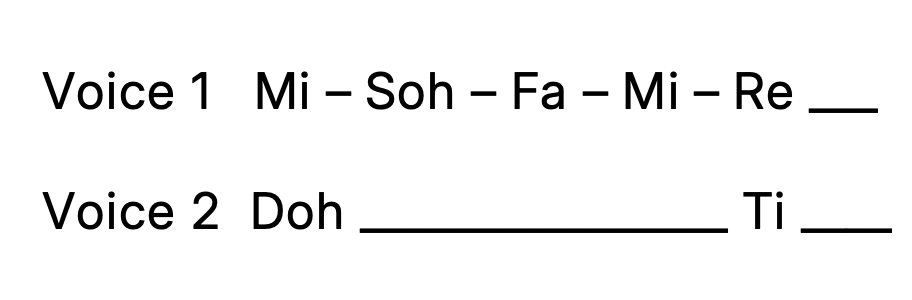
Accented passing notes draw expressive attention to the dissonance as an intended consequence of the voice-leading:
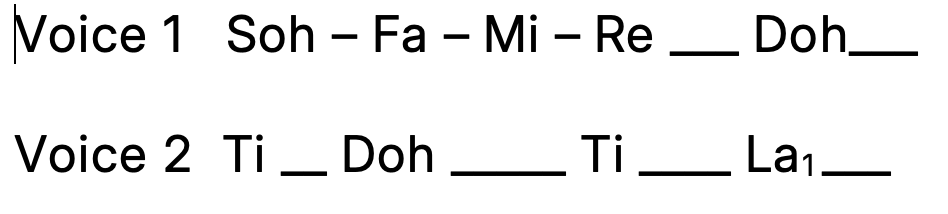
Accented passing notes thus represent an acceptance of dissonance within two-part polyphony, paving the way of the rhythmically responsive technique of suspension;
Suspensions can be viewed as displaced parallel consonance whereby one voice is delayed, causing a dissonance that is then resolved downwards by step. In acquiring fluency in the introduction of suspensions, it helps to apply the formula: Consonance – Preparation – Suspension- Resolution (C/P/S/R), and always to recall that suspension represents a rhythmic phenomenon rather than a mere harmonic choice. In a ‘chain of suspensions’, a resolution acts as the preparation for the following suspended dissonance.
Compare the following:
(A)
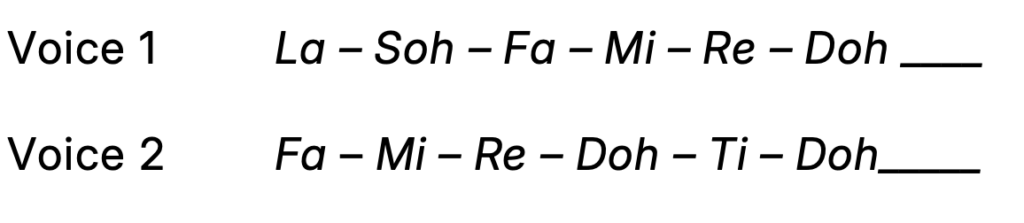
(B)
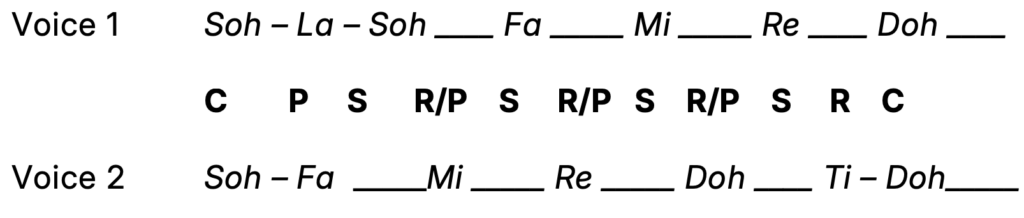
This variant of the example of accented passing notes (above) has been adapted to illustrate the use of suspension:
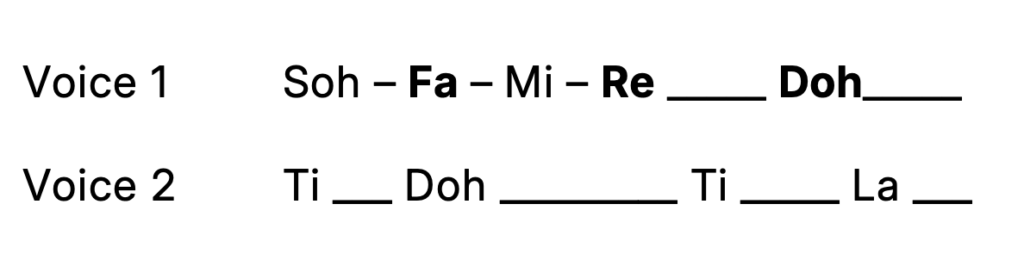
Anticipations are rhythmically speaking the opposite of suspensions in that one of the voices creates a dissonance with the other(s) by moving ahead of the anticipated consonance. For this reason, they feature expressively at the end of phrases and often decorate the final phrase of a piece. This example contains anticipations, marked A, with their resolution marked R:

The interaction between voices can combine these features of anticipation and suspension:
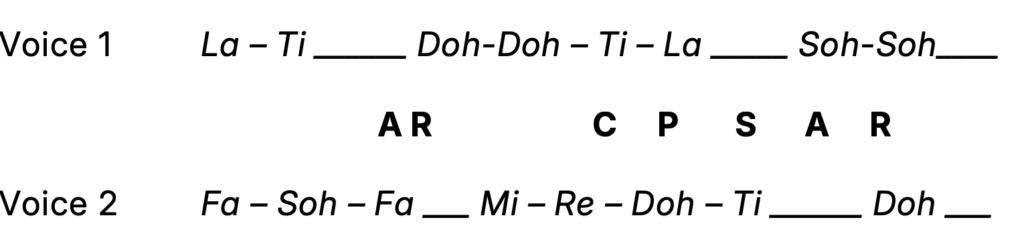
Free Renaissance-style polyphony. The following embraces several of the harmonic and intervallic feature outlined previously, and is frequently employed in Harmony Signing workshops to complete the phase dealing with two-part counterpoint (see Videos 36-41 for a sequence of improvised exercises that cover similar ground):

(repeat this immediately with the two Voices swapped over)
Videos 43-52 illustrate further steps in learning to sign two-part polyphony.