Mixed Mode Challenges Such As ‘Greensleeves’
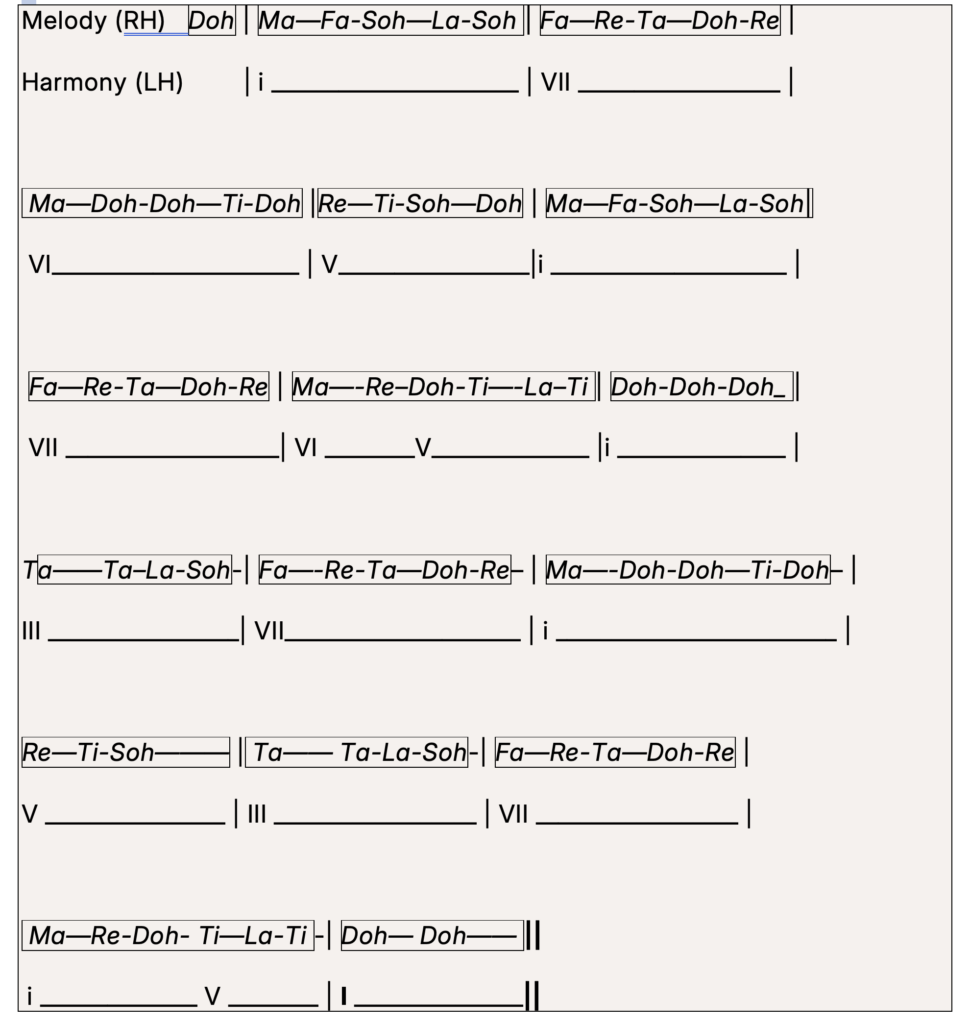
Once leaders and participants have become fluent in responding to two-handed Harmony Signing in which melody is led by the right hand and accompaniment with the left, turns can be taken to lead songs that may be familiar. This challenge proves a popular means of developing both individual and group competence at this level. It represents an excellent opportunity to practise Harmony Signing and to conceive of good examples to share with fellow-participants. But occasionally, one comes across a well-known melody whose properties unexpectedly demand procedures outside the current level of Harmony Signing knowledge. One typical example that initially proved a tough nut to crack is the popular song Greensleeves. Why should this have been so? And what solutions were found to ensure that it could be embraced into the repertoire accessible by the method?
To begin with, Greensleeves is in the minor mode. Not necessarily a problem, though different versions of the tune suggest either the Aeolian or the Dorian with a major note 6. Then there is the familiar harmonic progression with the bass falling by step (i-VII-VI-v), which does not sit easily with the Primary Triad foundations of Harmony Signing. Perhaps this relates to the traditional assumption that it was a solo song accompanied by lute, which lends an unfamiliar cast to the harmony compared to the choral style of the early Renaissance with which it is contemporary.
Employing the adapted range of melodic signs employed in Harmony Signing rather than the more varied practice of the Kodály stable, and by setting the performance in Doh minor rather than the accepted minor practice in Kodály of adopting La as the tonic, a coherent way of signing Greensleeves begins to emerge. The Doh minor decision is especially strategic in that versions of the song pass through both major and minor varieties of chords v and V as well, in the case of finishing with a tierce de Picardie, of both chords i and I.
Essential to signing the harmony of Greensleeves is the use of the Chord of the flattened 7th, VII, which is signed by moving the left hand across and outside the body to a horizontal position in which the index finger points downwards as in the sign for ta. That takes care of a chord that features prominently in the song. The second technique that one needs to have ready is the realisation that, in Doh minor, there is a reversal of some of the relationships between the Primary and secondary triads that occurs in the Major. The minor versions of the three Primary triads (i, iv and v) are signed by tilting the hand so that the palm faces the participants. On occasions for which any of them might be replaced by their major version, the hand simply returns to its normal, flat-edged position. It is the secondary triads that undergo transformation. In the minor, ii is a diminished triad (note 2, 4 and flat 6), and is not employed in Greensleeves. But significantly, III and VI, signed with the balled fist shifted a little beyond the Primary Triad positions for v and i from which they are derived, have become Major triads in comparison with their role as minor triads within tonicised Major tonality (see Tonicising).
With all this in mind, let’s set out a version of Greensleeves that employs the properties discussed: