
Rhythmic Patterns In Chord Progressions
Most of the exercises introduced thus far have provided a limited representation of the role of rhythm, and where this has occurred it has largely been achieved by the use of grouping and proportion in diagrams (see, for instance, the example which draw on the music of Purcell in Adding bass lines and getting into four harmonic parts, or Mussorgsky and Holst in The octatonic scale/second mode of limited transposition). Harmony Signing was never intended to be conveyed on paper or computer screens: it is a gestural language employed to link movement to musical sound, performed by human beings in response to one another in the same room. The diagrams provided on this website, as well as those and the musical notation presented in the books Every Child a Composer and First Instruments, are a means to an end, never an end in themselves, and should always be viewed as such. However, in order to convey the progressions and pitched potential of employing Harmony Signing as well as its critical reliance on Kodály hand-signs, representing these components has necessarily taken precedence in what has been dealt with.
Viewing the Videos will have illustrated that rhythm and it gestural control have by no means been absent from the exercises demonstrated. Nor, indeed, should they be: every lesson and every warm-up in a choral rehearsal should complement pitched exercises with rhythmic activity, such as clapping, body percussion, and counting games. The parts of the brain that respond to and control rhythm must not be neglected!
This section of the website proposes some ways in which rhythmic activity can enrich and extend the musical vocabulary of exercises that present chord progressions. Chord choice and sequence can be provided with new meaning, energy, and structural relevance through incorporation of the element of rhythm.
We could begin by providing a means of exploring the capacity of the 12-bar Blues to act as the basis for vocal composition or instrumental improvisation. The Blues pattern can be represented as follows, harnessing in a specific order the three positions of the Primary Triads:
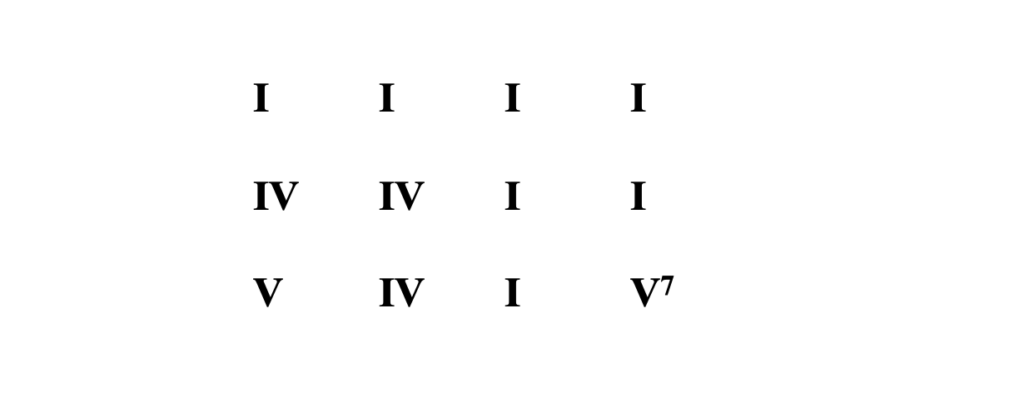
Let’s start by singing these to a vocalisation such as ‘BA’ that commences with a percussive consonant – 4 crotchet (quarter-note) beats on each chord.
Once the progression is clear and confidently memorised, we can add vocal percussion as well as a more lively, scat-style performance of the chords to a rhythm such as the following, spread over each four bars:
Ba–Ba– Baa—– | BaBa! – Ba Baa—– ||
The rhythm will be repeated six times in relation to the 12 bars of the Blue progression (take care with the third line, bars 9-12, because they need to cope with the most rapid changes of chord).
Once this is in place, one might add an independent bass line to walking crotchets (quarter-notes):
Doh-Mi-Soh-La |Ta-La-Soh-Me | Doh-Mi-Soh-La |Ta-La-Soh-Me
Fa-La-Doh1-Re1|Ma1-Re1-Doh1-La | Doh-Mi-Soh-La |Ta-La-Soh-Me
Soh-Ti-Re1-Soh | Fa-La-Doh1-Fa | Doh-Mi-Fa-Fi | Soh-Fa-Me-Re :||
These components can be ordered and combined with others (melodic, percussive, adding 7ths to the chords, etc.) to provide a basis for exploring the Blues. The version given is suitable for a rapid, rock-style tempo. Alternative versions could be attempted at a much slower tempo, adding melodic blue notes, etc. as well as being sung to texts.
What other means might be employed to exploit the capacity of Harmony Signing to combine with rhythm? One could set a time signature in motion in order to endow a sense of harmonic rhythm, as will have been the case in considering the bass line and chord progression of Pachelbel’s Canon in triple time (see Adding bass lines and getting into four harmonic parts for a version of this. Similarly, a driving rock in 4/4 underpins the bass riff of the Rolling Stones’ Satisfaction).
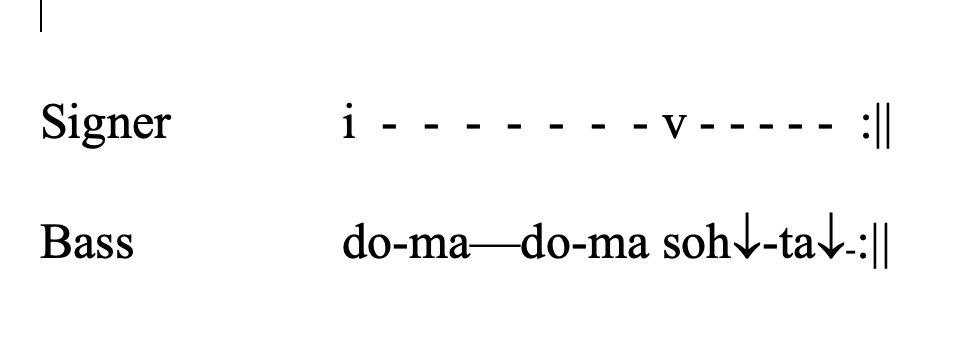
Dave Brubeck’s Take Five provides a window on the combination of a characteristic rhythm – 5 beats in a bar – together with an equally characteristic harmonic field, the minor mode with a minor dominant. Here, chord i is accorded three beats and v just two, which together define the unique feel of the piece:
As in the case of introducing previous elements of Harmony Signing pedagogy, students can select in response either to follow up with an analytical, repertoire-based activity – seeking out examples they can reconstruct based on these procedures that parallel the Purcell, Brubeck and Rolling Stones examples – or devise their own original patterns of harmonic rhythm, mode and chord progression with which to improvise, or complete a composition.
Here are some additional suggestions for basing progressions on rhythmic patterns:
Select a rhythmic configuration and employ it to explore a chord progression: e.g. 3 beats/1 beat
Listen to the song Hare Krishna from the musical Hair! and try a version of its rhythmic pattern:
Here is the original soundtrack recording: https://www.youtube.com/watch?v=5Aj1YVHXMQM
Can you also capture the distinctive circle of fifths progression?:

Listen to the 2 beats/1 beat pattern of the song Now, Oh now, I needs must part by John Dowland and work out how to represent it through Harmony Signing. This recording will help: https://www.youtube.com/watch?v=AweUIsbL7zs
Set up a Calypso rhythm with the beat structure 1-2-3 / 1-2-3 / 1-2 / 1-2 / 1-2 and decide on a chord progression that fits this for the music you would like to play.